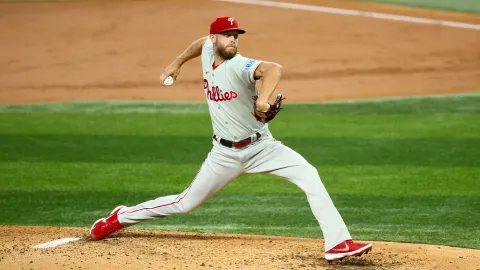
The Philadelphia Phillies already sit comfortably among the National League’s elite, but comfort has never been enough in a league increasingly dominated by superpowers. When the Los Angeles Dodgers can seemingly add an MVP, a Cy Young candidate, or a global superstar at will, standing still is the fastest way to fall behind. And while the Phillies’ roster remains loaded with star power, one area quietly flashing warning signs is the starting rotation.
On the surface, the Phillies look fine. Dig a little deeper, though, and the cracks begin to show — and that’s where the whispers start.
Zack Wheeler is coming off an injury. Ranger Suárez is headed toward free agency. Jesús Luzardo is approaching the final stretch of his deal. Aaron Nola, long the rotation’s steady backbone, is coming off a down year that raised uncomfortable questions. Individually, none of these facts spell disaster. Taken together, they form a picture that’s harder to ignore — especially for a front office that prides itself on staying one step ahead of the market.
That’s why a growing number of insiders and analysts believe the Phillies’ recent silence isn’t accidental.
FanSided’s Zachary Rotman recently put a name to what many around the league have quietly been circling: NPB superstar Tatsuya Imai. And once that name enters the conversation, it’s hard to shake the feeling that something bigger may be brewing behind closed doors.
Dave Dombrowski, after all, hasn’t exactly been subtle about his ambitions in Japan. He’s openly stated his desire to make a splash in the NPB market, and the Phillies have done their homework overseas for years. Scouting trips don’t make headlines. Quiet meetings don’t leak. But history suggests that when a front office goes quiet, it’s often because it doesn’t want competitors catching on.
And the timing here is… curious.
The Phillies are saying all the right things publicly — confidence in their rotation, belief in internal options, patience with the market. Yet nothing about their current situation screams patience. Suárez’s likely departure alone creates a looming void. Wheeler’s health adds uncertainty. Luzardo’s contract status creates pressure. Nola’s inconsistency introduces risk. That’s four separate rotation questions, all converging at once.
Since when does Dave Dombrowski ignore that many warning signs?
Rotman didn’t mince words when outlining why Imai makes sense. “The Phillies still need to add to their roster, and few players figure to be more impactful than Imai,” he wrote. And that’s where this conversation shifts from speculative to dangerous — for the rest of the league.
Tatsuya Imai isn’t just another international arm. Over eight seasons in Nippon Professional Baseball, he’s compiled a 58–45 record with a 3.15 ERA, 907 strikeouts, and a 1.267 WHIP across 963 innings. Those numbers don’t jump off the page by accident. They reflect durability, consistency, and an ability to miss bats — the exact traits MLB teams pay a premium for in October.
More importantly, Imai fits the Phillies’ timeline perfectly.
He wouldn’t be asked to carry the rotation alone. He wouldn’t need to be the savior. Instead, he’d slide into a role that maximizes his strengths while insulating the team against risk. Pair him with a healthy Wheeler and a rising Christopher Sánchez, and suddenly the Phillies don’t just have depth — they have leverage.
A true 1-2-3 punch.
And that’s where the conspiracy-minded fans start connecting dots.
Why haven’t the Phillies aggressively addressed pitching publicly? Why the repeated emphasis on “monitoring” rather than “acting”? Why the confidence that everything will sort itself out, despite clear contractual and health concerns?
Because maybe it already has.
Adding Imai would do more than just replace Suárez. It would future-proof the rotation. It would ease pressure on Wheeler’s workload coming off injury. It would give the Phillies insurance against Luzardo’s potential departure. And it would allow Nola to reset without carrying expectations he’s struggled to meet recently.
Most importantly, it would send a message — not just to the Dodgers, but to the entire league — that the Phillies aren’t content being good enough.
There’s also the financial angle. A deal projected in the $150–$160 million range would certainly raise eyebrows, but this is an ownership group that has shown a willingness to spend when it believes the window is open. With Bryce Harper, Trea Turner, and a core firmly in its prime, the window isn’t just open — it’s wide.
And windows don’t stay open forever.
The Dodgers understand that. The Phillies do too. The difference is how loudly each team operates. Los Angeles makes noise. Philadelphia works in shadows.
If Imai were to land in Philly, it wouldn’t just reshape the rotation — it would reframe expectations. Suddenly, October matchups look different. Suddenly, a short playoff series becomes a chess match instead of a gamble. Suddenly, the Phillies are the team no one wants to see lining up three legitimate frontline starters.
And maybe that’s why the silence feels so heavy.
In modern baseball, rumors don’t always leak when they’re true. Sometimes they leak when teams want them to. Sometimes they don’t leak at all until the deal is done. The Phillies’ quiet approach, combined with Dombrowski’s history and the rotation’s clear pressure points, makes it hard to believe this is all coincidence.
Timing isn’t random.
Whether Tatsuya Imai ultimately wears red pinstripes or not, the fact that his name keeps resurfacing says something. The Phillies know what they need. The league knows what the Phillies might be planning. And until a move is made — or definitively ruled out — the silence will only grow louder.
Because if this signing happens, it won’t feel sudden.
It will feel inevitable.
Leave a Reply